Revision 4
General Field Safety Rules
Foreword
This document concerns only the model-flying activities of W&DMFC members, and bona fide guests, at the club’s official site at Goldsborough.
Members entering into private arrangements to fly from other locations assume individual responsibility for all safety matters relating to it. Any and all legal or safety Issues arising from such arrangements remain a matter solely between the parties involved.
Introduction
All flying activities at Goldsborough are classed as recreational and must be carried out in compliance with sections of the Air Navigation Order 2016 relating to “Small Unmanned Aircraft”( SUA)
All pilots of model aircraft ( Conventional, Drone or FPV – that weighs between 100g and 25kg ) must be registered with the Civil Aviation Authority (CAA) and be able to provide ‘Operator and/or Flyer I.D. on request. The Over 25kg scheme is run by the Large Model Association(LMA) in association with the UK CAA to allow model aircraft from 25kg up to 150kg to be flown legally in the UK. .
As day-to-day activity on the flying field varies with individual members` circumstances and opportunities, it is not possible to have the support and guidance of the club’s appointed safety officer available during every flying session. In practical terms, the Club Safety Policy empowers each individual club member with the authority to act on behalf of The Club in enforcing that policy.
Effective management of the risks present during any flying session can be achieved so long as every club member is committed to safety on our site and actively supports these basic ‘General Field Safety Rules..
The relatively small membership of the club promotes an informal comradeship and it is expected that this, with the assistance of these general rules, will suffice to ensure that the club’s safety record is maintained.
The General Field Safety Rules presented here are practicable, reasonable and workable, and only formalise what should already be standard practice.
FLYING SITE DIAGRAM
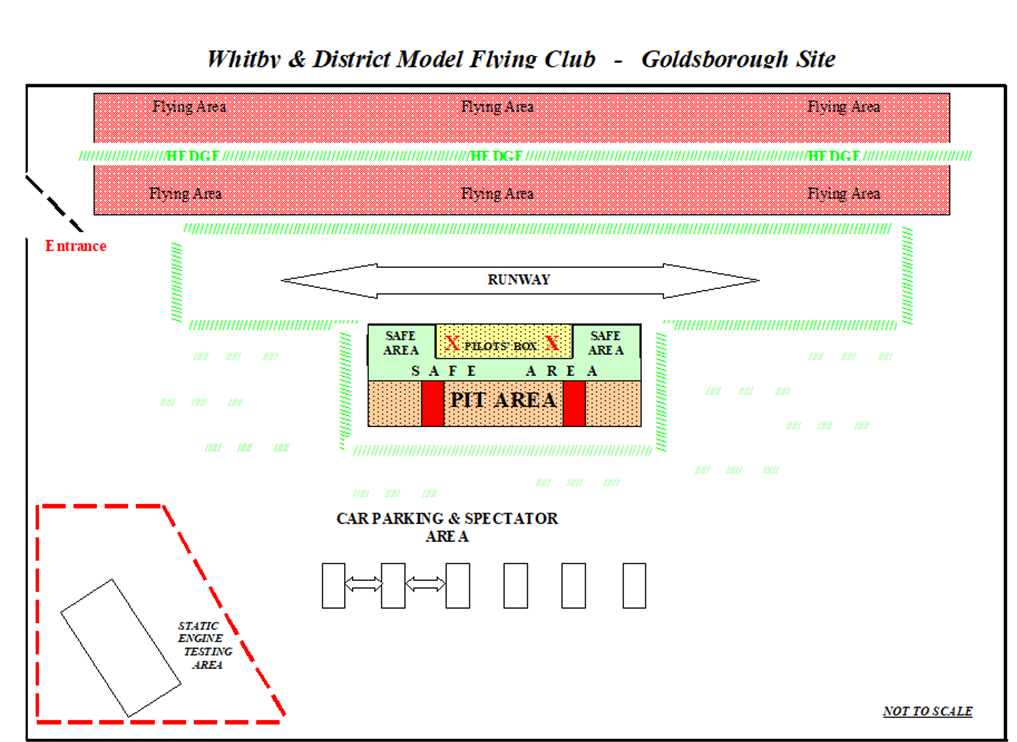
Access, parking, welfare and environment.
- Pedestrians and drivers are responsible for entering, leaving and moving around the site in a safe manner.
- As the take-off and landing flight paths usually overfly the entrance gate area, on entering the field all pedestrians and vehicles should proceed immediately to the parking/spectator area, as marked on the site plan.
- Whilst members should provide for their own first aid requirements, a back-up first aid box is available, located in the container.
- A camping style toilet facility, comprising pan / biodegradable soil bags and privacy tent is stored in the container for use by members only. Please note : If you need to use this facility it is your responsibility for the same day removal and ultimate disposal of the soil bag.
- Club members should ensure that litter is not dropped on the site and that environmental issues are considered carefully.
- Public / Spectator area.
Members of the public are most welcome to visit and observe our flying sessions. Unfortunately, they usually do so from a vantage point on Goldsborough lane, by the gate – not an ideal location given the `normal` take-off and landing flight paths.
The warning notice, stored in the container, should be prominently displayed by the field entrance gate at the start of each flying session. Members are requested to approach any spectators lingering around the site entrance and advise them of the hazards, whilst at the same time extending an invitation to use the on-field parking and spectator facilities.
Visitors to the field must be invited to remain within the designated spectator area, as marked on the site plan.
The safety of persons having right of passage through the field for the movement of livestock etc., must take precedence over flying activities for the duration of their presence.
If and when notified by the estate manager / nominee of the need to move livestock through the field :-
- All airborne models must be landed immediately and retrieved to the pit area.
- No take-off manoeuvres are to be initiated during the shepherding.
- No engines (I.C. or Electric) are to be run during the shepherding.
Young Persons and Vulnerable Adults
As defined in law these are, respectively, any person under eighteen (18) years of age, and any person of eighteen (18) years of age or over but who through mental or physical attributes, requires a higher level of supervision than would be normally commensurate with an adult.
With the exception of junior club members operating within a training programme and under the direct control and supervision of a senior club member, young persons and vulnerable adults are not allowed into the pit area or onto the flight line/runway. They must remain in the spectator area under the close supervision of a responsible adult at all time
It is the responsibility of all club members to ensure that their family members, friends or guests are made fully aware of these stipulations in respect of young persons and vulnerable adults attending the flying site, and for ensuring that adequate adult supervision is being provided and maintained. Children can wander and are by nature curious, but model aircraft engines, operating at even slow speed, have the potential to inflict severe injuries.
Any communication by email between juniors/vulnerable adults and the club must be copied to the parent, legal guardian or authorised carer.
Tx control
All 35/27 Mhz transmitter operations to be managed by understanding and agreement between all pilots on-site at any given flying session. Use of the ‘Pegboard’ is to remain an option where a larger number of fliers on these frequencies may compromise the more informal arrangements. If in doubt – use it !!
Where BMFA affiliated clubs are formally invited to fly at W&DMFC’s site, prior notice will be requested of any intended 35/27 Mhz operation and, if confirmed, the ‘Pegboard’ must be used.
Pit area
This area, as marked, is strictly reserved for the setting up and maintenance/repair of models and is the only area behind the flight line where model mounted engines (I.C. or Electric) may be run-up in preparation for flight.
Note:
1. Engines (I.C. or Electric) brought to the field for test running purposes only must be securely mounted on a test bench of adequate design and operated within the designated area, as shown on the site plan.
2. Engines running ‘on test’ must never be left unattended.
3. Junior members, up to sixteen (16) years of age must receive formal instruction from a competent senior club member on the correct and safe engine start-up procedures (I.C. or Electric), and must never be allowed to attempt to start an engine without the direct supervision of senior club member.
4. Junior members of sixteen to eighteen (16-18) years of age may start engines unsupervised only after a demonstration of knowledge and proficiency in safe starting and operating techniques is performed to the club Safety Officer’s satisfaction.
Because of the risks associated with the fundamental hazard created by model engines turning propellers at high speed, those not directly involved in operating, or assisting with, the models are not permitted into the pit area or testing area unless they are senior club members, or adult guest fliers accompanied by a senior club member.
The pit area is also the only area, besides the flight line, where transmitters may be operated, except for range checking (see also Tx control).
Non-member adult spectators requesting a ‘close-up’ of a particular model must be encouraged to do so away from the pit area.
Pit Safety
Layout of each pit should be such that the model is pointing away from the spectator area and not towards any other pit.
Power models ( I.C. or Electric ) to be securely anchored during engine run-up.
Once the engine is running, the area immediately to the front and side of the propeller is to be vacated, with all adjustments made from behind the revolving propeller.
Assistance in carrying the model from the pit area to the flight line should be sought if appropriate.
Flight line / Pilots Box
This area, as marked, is strictly reserved for pilots operating airborne models, and those preparing for take off or retrieving landed models.
General take-off, flying and landing procedures
All “Taking off”, “Landing” and “Deadstick” announcements to other pilots must be loud and clear.
“Emergency” announcements must be equally loud and clear and should prompt ‘non-active’ club members to engage in the incident, assess the hazard and move to warn visitors/spectators etc of potential risks.
Taking off :
Taxiing under power from the pits to the runway must not be undertaken. Once in position on the runway a full functionality
check on all controlled surfaces is to be made with the engine running at operating speed.
Hand launching:
The model is to be taken out onto the runway and must not be hand launched from the pit area or the pilots’ box.
With all but the lightest of models an assistant, who is familiar with the technique, should undertake launching. This is especially so where the model is large and/or strong winds prevail,
In all cases, once the model is airborne, retire immediately to the Pilots Box.
Airborne matters :
- Pilots must not fly in a manner that is liable to cause a mid-air collision and must observe the etiquette of the day in respect of left or right-hand circuit flying.
- Flying over parking, spectator and pit areas must be avoided at all times.
- The optimum number of airborne models at any given time is that which does not create a level of congestion requiring pilots to continually take evasive measures in order to maintain normal circuit speed, height or direction.
- Helicopters / ‘Park Fly’ models whose range of operation is generally limited to an area directly in front of the pilots’ box must not be flown in a manner likely to cause distraction or loss of concentration to pilots of conventional fixed wing models using this area of the field for take offs and landings . In order to remove this potential hazard agreement must be reached with other members present on the allocation of a reserved time slot for the flying of helicopters and park fly models.
- “Test bed” designs, or new models of uncertain handling characteristics should ideally be ‘ maidened’ during periods of low attendance at the field, with an appropriate word of caution to those present !
- “Multirotor” (Quadcopters / Drones) are to be flown under the same provisions applying to Helicopters/Park Fly models. Further, these machines must only be operated within visual range of the pilots’ box and only then on the very clear understanding that absolutely no hovering, filming or photographing (actual or perceived by persons on the ground) is to be undertaken of any private dwellings, individuals or personal/work activities within the operating range of these machines whilst they are airborne. Neither must they be hovered at low level over livestock in adjoining fields.
- As the Club’s site facilities cannot safely accommodate low level, high speed, ‘Drone Racing, this activity is expressly forbidden.
- FPV models are only permitted to operate within prevailing BMFA guidelines and all flights must be supported by a ‘spotter’.
Radio controlled flight of fixed wing model aircraft is a well-established discipline with proven protocols to ensure generally safe and secure operation. Whilst newer concepts of remotely operated airborne models are welcomed by W&DMFC, the club reserves the right to suspend immediately and without notice the operation of these models should it be made aware of any safety or’ invasion of privacy’ issues arising from their operation at the club’s official flying site, and whilst the club cannot control their use away from its own site, inappropriate or unsafe operation which results in prosecution of a club member through the civil courts will be considered as bringing the club into disrepute and may result in suspension of membership.
Looking ahead
In order to ensure the club’s continued support for the evolving technological developments in our sport club members should, as a matter of courtesy, notify the committee in advance of any proposal to introduce “latest technology” onto the field which may require special consideration or forfeit from other members present. They must also endeavour to have sufficient knowledge, understanding and control of the equipment involved to ensure that, in use, it presents no foreseeable risk to others and that both the equipment and its operation is covered by BMFA insurance, and complies fully with the Civil Aviation Authority’s directives on small unmanned aircraft ( SUA).
Landing :
Normal
After landing, reclamation of models must only be undertaken after clearance from active pilots on the flight line.
Landed models must not be taxied directly towards the pilots box but rather towards (but not into) the safe areas on either side, as shown on the site plan.
Deadstick
If the model cannot be brought back to the airstrip, it must be put down in a safe area away from the road and any livestock.
General Field Safety Rules (4)
Emergency
Any airborne malfunction, which impairs the normal or safe handling of the model, is to be classed as an emergency and clearly broadcast as such to others present.
Whatever degree of control remains, must be utilised to put the model down in a safe area away from personnel or livestock.
All debris from such an incident is to be retrieved from the crash site
Failsafe mode or devices, where available or fitted, must be set to shut down the motor and set the trim to contain the model in a descending circle.
Following the incident a full investigation must be undertaken and a report given, detailing the known or probable cause and must include any and all information which may be pertinent to any subsequent claim against our insurers.
Guest Fliers
Guest fliers are defined as individuals who are current members of any BMFA affiliated club which has been formally invited by The Committee of W&DMFC to visit and use the club’s flying site facilities
All visiting fliers must :
- Produce valid BMFA insurance documentation, if requested.
- Produce valid CAA certification ( Flyer I.D. & Operator I.D.).
- Submit their model(s) to W&DMFC’s Safety Officer/Appointee if requested to do so.
- Demonstrate acceptable pit safety disciplines.
In all cases, permission for guests to fly (or remain flying) is at the discretion of W&DMFC members present at the time and must cease flying if requested to do so.
General
This document is complimentary to current BMFA safety guidelines. Should conflict arise from any future adjustment to these guidelines, appropriate amendments will be issued.
(This document to be reviewed / revised as necessary and reaffirmed annually at the AGM“)